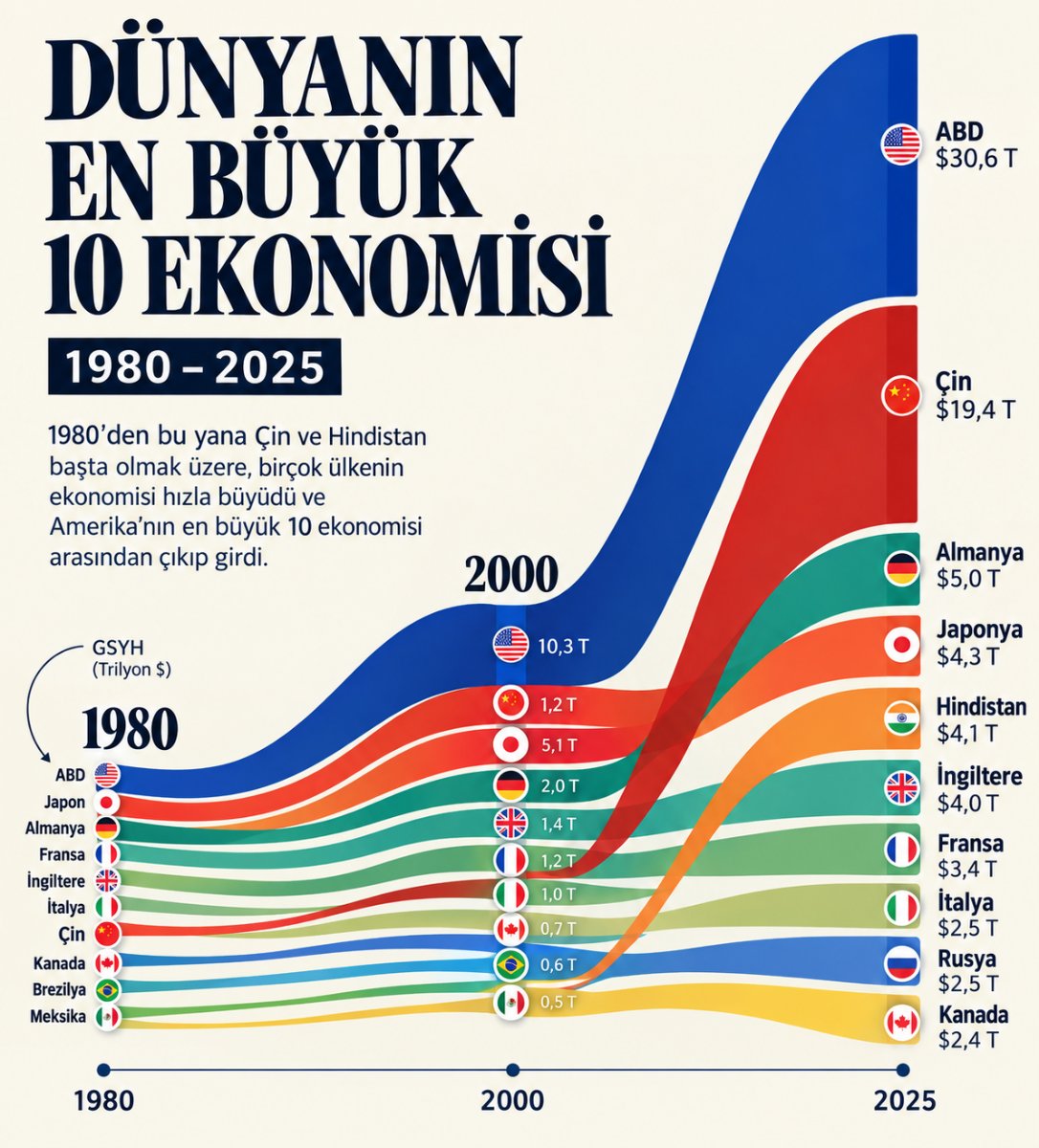
This table, spanning from 1980 to 2025, clearly summarizes how the balance of power in global trade has fundamentally shifted.
In 1980, China was ranked lower, while European giants (Germany, UK, France, Italy) were the main centers of the global economy.
By 2025, the picture is completely different: China has reached a colossal economic power of 19.4 trillion dollars. European industrial giants like Germany ($5.0T), the UK ($4.0T), and France ($3.4T) lag behind the enormous scale created by China and the US. This situation is not just a race of numbers; it's a transformation of supply chains, production power, and market dominance.
As Europe loses ground against China's dominant rise in the global market, trade strategies are also changing. Simply producing goods remotely and exporting them is no longer enough for competitiveness.
In this major transformation, there is a clear lesson for manufacturers: the way to stay in the game in global markets is not to be a cross-border supplier to the target market, but to position oneself as a local player within the market. As traditional markets become constrained and competition between China and Europe intensifies, structures that are actively present in major markets like the US and build local trust will win. How do you think Europe will be able to strike a balance against this production and market pressure in the coming period?
In 1980, China was ranked lower, while European giants (Germany, UK, France, Italy) were the main centers of the global economy.
By 2025, the picture is completely different: China has reached a colossal economic power of 19.4 trillion dollars. European industrial giants like Germany ($5.0T), the UK ($4.0T), and France ($3.4T) lag behind the enormous scale created by China and the US. This situation is not just a race of numbers; it's a transformation of supply chains, production power, and market dominance.
As Europe loses ground against China's dominant rise in the global market, trade strategies are also changing. Simply producing goods remotely and exporting them is no longer enough for competitiveness.
In this major transformation, there is a clear lesson for manufacturers: the way to stay in the game in global markets is not to be a cross-border supplier to the target market, but to position oneself as a local player within the market. As traditional markets become constrained and competition between China and Europe intensifies, structures that are actively present in major markets like the US and build local trust will win. How do you think Europe will be able to strike a balance against this production and market pressure in the coming period?